In Event horizon, singularity and escape velocity, the utility horizon ends with "Eventually, death cured." Here's how I think the road to that looks in healthcare, one milestone at a time.
01Why medicine is slow today
A new drug is a long, expensive bet. Most of them lose.
- About $2.6 billionThe average cost to bring one new drug to approval, counting the failures along the way (Tufts, 2014, in 2013 dollars).
- 7.9%The share of drugs entering human trials (Phase I) that went on to be approved, 2011 to 2020.
- Years of testingLab, then animals, then three phases in people. Every step waits on the one before it.
The slow part isn't ideas. It's testing. You can't know how a drug behaves in a body until you put it in one, and bodies are slow, costly and different from each other.
02The first major milestone: a perfect human simulation
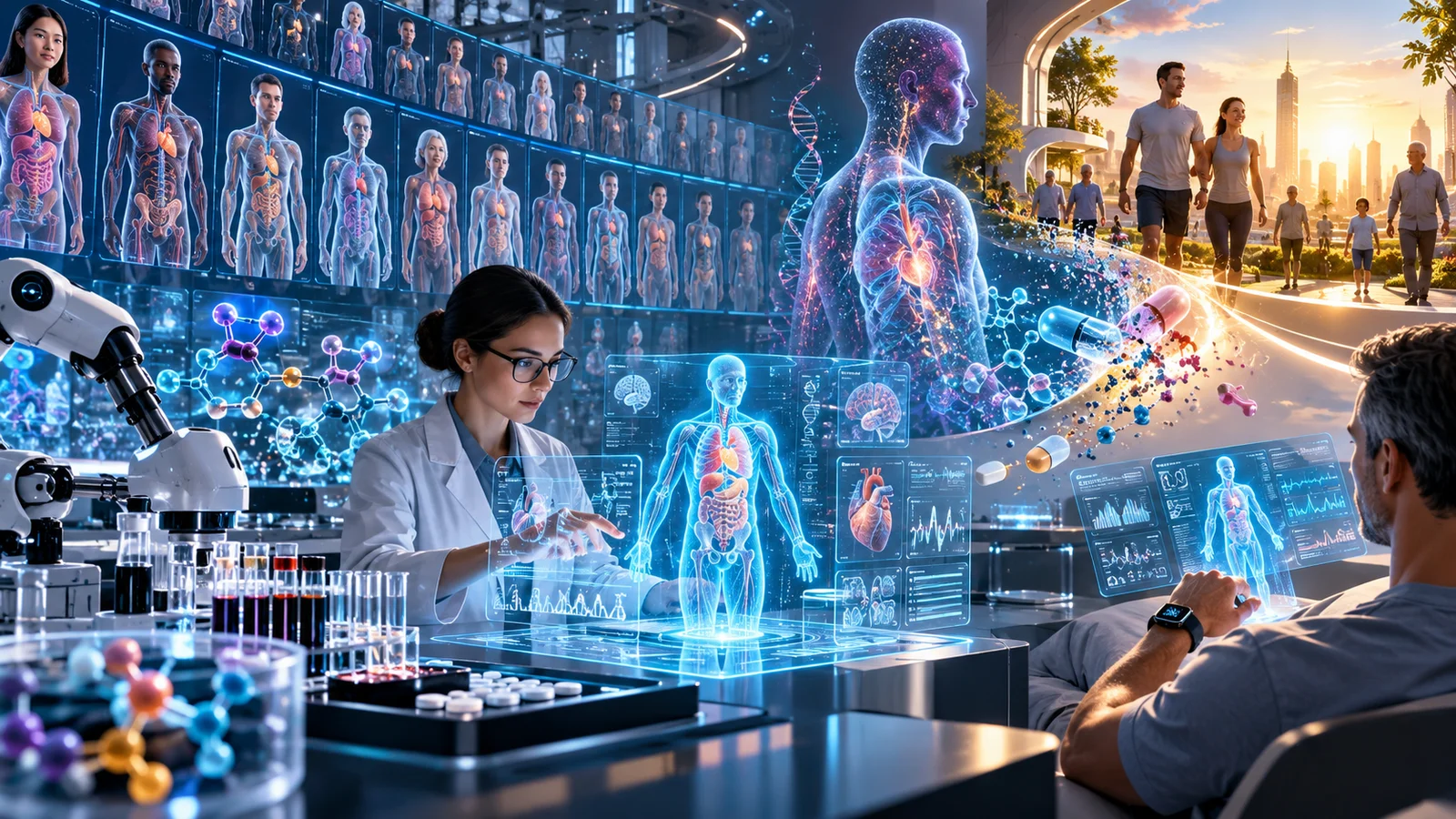
A perfect human body, in software. Not one. A whole bunch of them: young and old, men and women, every kind of genetics and health history. Run every drug test on them. Get results that are statistically significant. Approvals can then be rapid.
This has started in small ways. The University of Virginia's type 1 diabetes simulator, a population of virtual patients, was accepted by the US FDA as an alternative to animal testing for insulin control systems. On 10 April 2025, the FDA announced a plan to reduce, and eventually replace, animal testing for monoclonal antibodies and other drugs. AI-based computational models of toxicity are one of the methods it named.
Those are narrow simulations of one system. The milestone is the whole body. Once we have it, two stages follow.
03Stage 1: Repurpose
Run every drug we already have through the simulation, against every disease. We'll get a new list of uses for old drugs. I think that list can be many times longer than the list of cures we have today.
The search space is big but finite. Every Cure, a non-profit, scores about 4,000 approved drugs against about 18,000 recognised diseases. That's about 75 million drug-disease scores.
It has already paid off:
- Baricitinib was a rheumatoid arthritis drug. On 4 February 2020, BenevolentAI used AI to suggest it for COVID-19 in The Lancet. In November 2020, the FDA authorised it for emergency use in hospitalised COVID patients. That took nine months.
- Halicin was once studied as a diabetes drug. In 2020, an MIT model picked it out as an antibiotic that killed many drug-resistant bacteria in lab tests.
(Repurposing is the fast stage. These drugs already passed safety testing in people.)
04Stage 2: Rapid drug discovery
Next, the simulation is good enough to react the way a body would. So we stop limiting ourselves to old drugs. AI creates new chemical combinations and tests them on the simulated bodies. A million mix-and-matches overnight, and voila: the cure for death.
The search half of this exists today:
- In 2020, the same MIT team screened more than 100 million molecules in three days.
- Rentosertib, a drug whose target and molecule were both found with AI, finished a Phase 2a trial in 71 people with lung fibrosis. Results came out in Nature Medicine in June 2025. Over 12 weeks, lung capacity on the top dose rose by an average of 98.4 mL. On placebo it fell by 20.3 mL.
What's missing is the testing half. Rentosertib still had to be tried in real people, because no simulation is trusted to stand in for them yet. The perfect human simulation is what closes that gap.
05Step 3: Your own simulation
This is when every human can have their own simulation made, the way photocopies are made today.
Your copy carries your genes, your blood reports and your history. Before you take a drug, your copy takes it first. The dose gets tuned to you. Side effects show up on the copy, not on you. A second opinion means running the same question on your copy again.
- Milestone: a perfect human simulationMany simulated bodies. Every drug test runs on them, with statistically significant results. Approvals become rapid.
- Stage 1: RepurposeEvery old drug against every disease. A new list of uses, many times longer than today's list of cures.
- Stage 2: Rapid drug discoveryNew chemical combinations, a million mix-and-matches overnight, tested on bodies that react like ours.
- Step 3: Your own simulationA copy of you, made as easily as a photocopy. It takes the drug before you do.
06What could slow it down
- The model is only as good as its data. Bodies are messy, and a simulation that's wrong in a small way can be confidently wrong at scale.
- Regulators need proof. A simulation has to be checked against real patients before anyone trusts it in their place. That takes time, and it should.
- A copy of your body is the most private data there is. Who holds it, and who can run tests on it, matters.
- It's the same engine. A system that can design a cure overnight can design harm overnight too. That's why alignment comes first.
07The short version
- Medicine is slow because testing is slow: about $2.6 billion per approved drug, and only 7.9% of drugs entering human trials get approved.
- The first big milestone is a perfect human simulation: many simulated bodies, statistically significant results, rapid approvals.
- Stage 1 repurposes old drugs. Stage 2 discovers new ones overnight. Step 3 gives every person their own copy to test on.
08Sources
- DiMasi, J. A., Grabowski, H. G. and Hansen, R. W. (2016). Innovation in the pharmaceutical industry: New estimates of R&D costs. Journal of Health Economics 47. (Tufts Center for the Study of Drug Development, first released 2014.)
- BIO, Informa Pharma Intelligence and QLS Advisors (2021). Clinical Development Success Rates and Contributing Factors 2011–2020.
- Kovatchev, B. P. et al. (2009). In Silico Preclinical Trials: A Proof of Concept in Closed-Loop Control of Type 1 Diabetes. Journal of Diabetes Science and Technology 3(1). University of Virginia, Commercially available U.Va. diabetes simulator accelerating the pace of research and development.
- US FDA (2025). FDA announces plan to phase out animal testing requirement for monoclonal antibodies and other drugs. 10 April 2025.
- Every Cure, via Elsevier (2024). Every Cure: turning old drugs into new hope.
- Richardson, P. et al. (2020). Baricitinib as potential treatment for 2019-nCoV acute respiratory disease. The Lancet 395, 4 February 2020. US FDA Emergency Use Authorization for baricitinib, November 2020.
- Stokes, J. M. et al. (2020). A Deep Learning Approach to Antibiotic Discovery. Cell 180(4), 20 February 2020.
- Insilico Medicine (2025). Phase 2a results of rentosertib, a TNIK inhibitor for idiopathic pulmonary fibrosis, published in Nature Medicine, 3 June 2025; reported in Drug Discovery & Development, 5 June 2025.
All posts
Appointment setting3
Copywriting3
Deep Think AI14
- What is intelligence, really?
- What is artificial intelligence?
- AI comes in degrees: narrow, general, super
- What is AI alignment?
- Why alignment is a big deal
- How do you make AI aligned?
- What happens when AI isn't aligned?
- What are the chances AI stays aligned?
- What an aligned AI world looks like
- What a misaligned AI world looks like
- Rogue AI: what it looks like
- Event horizon, singularity and escape velocity
- Can AI feel?
- What AI progress looks like in healthcare



Comments
Loading comments…
Leave a comment