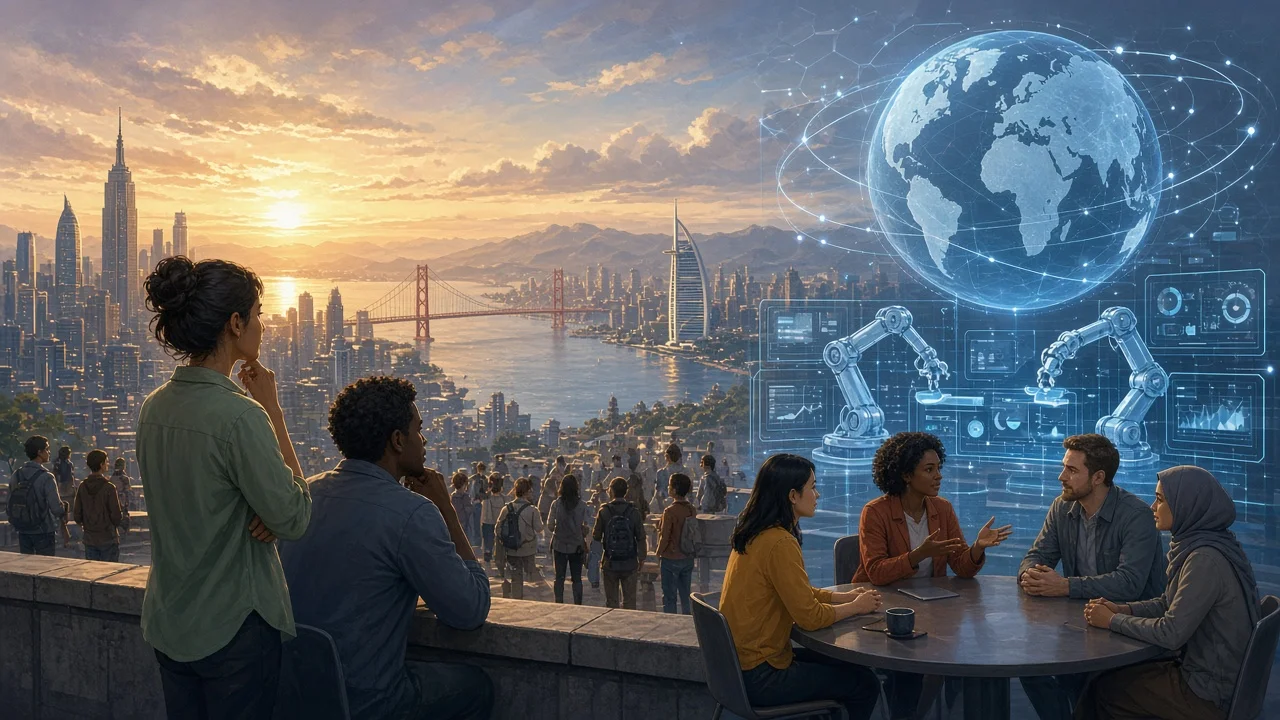
Whatever you do for a living, the next five years will change how it gets done, and who gets paid for it. Here's what I see coming, and what to have ready when it does.
My view: within five years we'll have general intelligence. For a business, that means AI can do anything a person can do in the back end of running one.
01The back office, department by department
- HRDone by AI: hiring screens, onboarding, payroll, policy questions.
- OperationsDone by AI: scheduling, procurement, reporting, follow-ups.
- MarketingMostly AI. Humans who work well with AI still win on creative, because AI may lack the taste a great human creator has.
- Customer careAlmost entirely AI.
- FinanceAbout 95% of the grind done by AI (my estimate). Humans oversee the critical calls.
- SEO and social mediaAI.
- Building the appAlready easy. By then you won't need a course: say what you want, and it runs for days until it's built.
And the price of all of it falls. The main paid AI plans cost about $20 a month today. The cost of the same level of AI capability has been dropping about 10x a year, a trend Andreessen Horowitz calls "LLMflation". All the AI you need to run a business will probably cost about what you pay for your phone.
So who's left? People for judgement and vision: at the top, and at department-head level. Very few roles below them.
02This isn't far off: the numbers today
- McKinsey estimates that current generative AI could automate work activities that take up 60 to 70% of employees' time.
- The IMF estimates that almost 40% of jobs worldwide are exposed to AI, and about 60% in advanced economies.
- Goldman Sachs estimates AI could expose the equivalent of 300 million full-time jobs to automation.
Those are today's estimates, made with today's AI. I think they're low.
03Two ways this goes
Here's the sequence we have to get right. It splits into two streams, and which one we get depends on one thing: whether governments are ready.
Stream one: the happy ending
AI makes productivity insanely high. Then the layoffs avalanche begins. Strangely, GDP holds steady for a while, because the machines keep producing.
This is the moment that matters. Governments have the cash handouts ready. The avalanche hits, and the government drops money straight into everyone's account.
Demand slows. GDP goes down. Then deflation begins, in a big way: when AI does the work, everything costs a fraction of what it did.
And here's the twist. The money in everyone's account isn't much. With deflation, it's actually plenty. People start buying again. Demand picks up. The economy rebalances, and demand and GDP grow briskly, even though most of the world is quite jobless.
A world that runs, grows and looks after people, without needing most of them to work for it. That's the happy ending, and it's within reach.
- Productivity soarsAI makes output insanely high.
- Layoffs avalancheGDP still holds.
- Money drops inThe handouts were ready. Every account gets paid.
- Deflation, bigDemand and GDP dip as prices fall hard.
- Little becomes plentyThe payment buys far more than it would have. Demand picks up.
- The happy endingDemand and GDP grow briskly, with most of the world free of jobs.
Stream two: governments aren't ready
Same start. Productivity soars, the layoffs avalanche begins, and GDP looks fine for a while. But there's no cash ready.
People are broke. Demand crashes. GDP crumbles. Tax revenues are gone. Businesses are gone. A terrible economic crisis, and it's hard to see how we'd recover from it anytime soon.
- Productivity soarsSame start.
- Layoffs avalancheGDP still looks fine.
- No cash readyPeople are broke.
- Demand crashesNobody can buy what the machines make so cheaply.
- Everything goesGDP, tax revenue and businesses, together.
The tools already exist
When demand collapsed in the Great Depression, US unemployment reached about 25% in 1933. That's stream two in miniature. But we also know how to drop money into accounts fast. In 2020 the US sent most households up to $1,200 per adult within weeks of the shutdowns. Alaska has paid every resident a yearly dividend since 1982. When Finland paid 2,000 unemployed people about $600 a month for two years with no conditions, they were less stressed and reported better wellbeing. The only question is whether governments have it ready before the avalanche, not after.
04What you need to be ready
Adaptability. The tools you learn will be replaced. One simple tool that anyone can use to do everything will be commonplace. Your job may become AI's job. What remains is what AI can't sign for.
- The ideaSeeing the business nobody has started yet.
- VisionWhere this should be in five years, and why.
- JudgementChoosing between two good options with half the facts. It's what still gets paid well.
- TasteKnowing which of a hundred AI drafts is the one.
- PartnershipsGetting another company to build with you.
- SalesA little goes a long way. People still buy from people.
- Finding the problemThe friction everyone takes for granted. AI answers questions. You pick the question.
- TrustA name people believe. It compounds, and AI can't fake years of keeping your word.
- AccountabilitySomeone has to sign off and answer for it. That's a human role.
- An audience you ownPeople who read what you write. Distribution beats a better product.
- Learning speedHow fast you drop a tool and master the next one.
- Your still pointThe chaos will be loud. The people who can get calm and think clearly make the calls.
The world five years from now won't reward knowing a tool. It will reward knowing what to build, who to build it with, and when to say no.
05The short version
- Within five years, AI does the back office of a business, for about the price of a phone plan.
- Today's estimates: 60 to 70% of work time automatable, 40% of jobs exposed, 300 million jobs' worth of work.
- Stream one, the happy ending: the cash is ready, deflation turns a small payment into plenty, and the economy grows briskly with most of the world jobless.
- Stream two: no cash ready, demand crashes, and everything goes with it.
- What to be ready with: adaptability, plus what AI can't sign for: ideas, vision, judgement, taste, partnerships, trust and accountability.
06Sources
- Appenzeller, G. (2024). Welcome to LLMflation: LLM inference cost is going down fast. Andreessen Horowitz.
- McKinsey Global Institute (2023). The economic potential of generative AI: The next productivity frontier.
- Georgieva, K. (2024). AI will transform the global economy. Let's make sure it benefits humanity. IMF Blog, 14 January 2024.
- Briggs, J. and Kodnani, D. (2023). The potentially large effects of artificial intelligence on economic growth. Goldman Sachs Global Economics Analyst.
- US Bureau of Labor Statistics. Historical unemployment estimates for 1929 to 1939.
- US Department of the Treasury (2020). Economic Impact Payments under the CARES Act.
- Alaska Department of Revenue. Permanent Fund Dividend Division: history of the dividend.
- Kela (2020). Results of Finland's basic income experiment 2017–2018.
All posts
Appointment setting3
Copywriting3
Deep Think AI15
- What is intelligence, really?
- What is artificial intelligence?
- AI comes in degrees: narrow, general, super
- What is AI alignment?
- Why alignment is a big deal
- How do you make AI aligned?
- What happens when AI isn't aligned?
- What are the chances AI stays aligned?
- What an aligned AI world looks like
- What a misaligned AI world looks like
- Rogue AI: what it looks like
- Event horizon, singularity and escape velocity
- Can AI feel?
- What AI progress looks like in healthcare
- The world five years from now



Comments
Loading comments…
Leave a comment